Baton: AI automation landing page template for Next.js.
- Next.js 16
- CSS
- TypeScript
- 9 sections
- Light
- No API keys
- Palette
- Updated Nov 4, 2026
01Overview
At a glance
A complete launch page for a product that runs agents or workflows between apps. The first thing a visitor sees is your product finishing a real job by itself. Then they see how a job is described, what a run looks like, when it stops to ask a person, and what it costs. Change the words in one file and the same page is about your product.
Made for
- AI agent builders and workflow automation tools
- Single-purpose AI assistants for support, sales or finance
- Founders who want the product on the first screen, not a promise
What stands out04
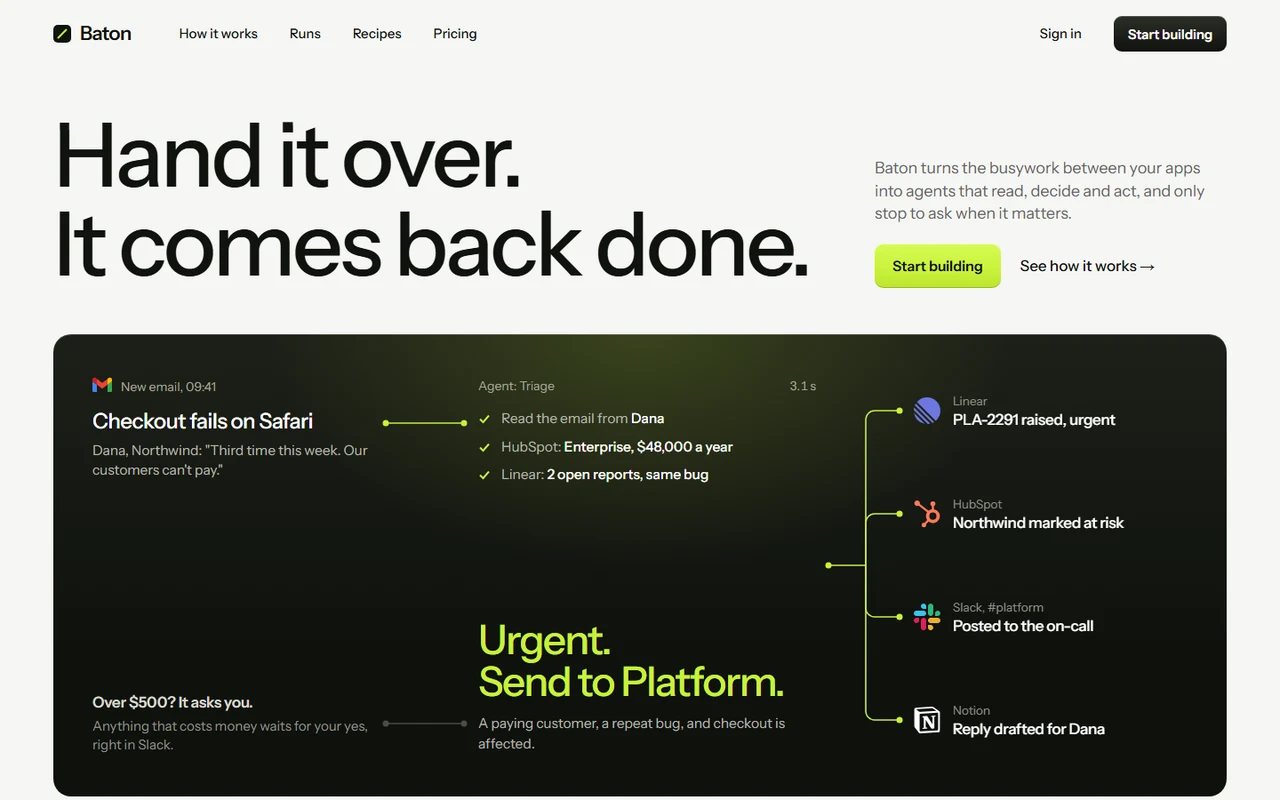
- A hero run that plays by itself: an email, three checks, a decision, then four actions along lit wires
- A plain-words brief that lights up phrase by phrase while its workflow draws itself
- Every step of a run on a seconds clock, in focus in turn, beside the agent's reason for it
- Its own grid of rails and ruler seams, a phone menu drawn as a small run, and a footer wired to its links
02The look
Its own palette and type
The colours and type it ships with. Tap a colour to copy it.
- AaInstrument SansIncluded with the template
The quick brown fox jumps over the lazy dog
0123456789
Instrument Sans on a cool off-white page, with one lime that means work happening now. The first screen is open: a headline and one dark surface. Below it, everything sits between two rails, with a fine ruler seam between sections and cells flush against them. Graphics are small pieces of real product, sharp where the work is and fading away from it. Everything plays by itself, slowly, with nothing to press.
03Sections
9 sections, in page order
From the first screen to the footer.
- 01
Hero
"Hand it over. It comes back done." over one dark surface. An email comes in, an agent checks the customer and open issues, decides, and the actions go out along lit wires one by one.
- 02
Say what you want done
A wire leaves the headline and lands in a white sheet. A brief in plain words lights up phrase by phrase, and each phrase draws its step of a branching workflow, with the app's colour under its icon.
- 03
Every run shows its work
Each step of a run sits at its start time on a seconds clock. Focus moves down the steps while the agent's reasons scroll beside them, each in plain words.
- 04
It stops and asks
The page's one big colour: a lime plate with a real message in a channel. The approve button presses and the message resolves.
- 05
Recipes
Three recipes shown working as pieces of the product (an inbox, a lead, a stack of invoices) over a plain grid of the rest, each wired from one app to another.
- 06
Proof
A customer's words set large beside a dark panel of the hours handed back, by team, over a strip of four figures.
- 07
Pricing
"Pay per run, not per seat", with the last words crossed out as they come on screen, over one flush sheet of three plans with the one to pick in dark.
- 08
Questions and footer
Every answer is open in flush cells beside a way to reach a person. The footer is one huge action with the links wired off it.
- 09
Pages
A changelog, privacy and terms placeholders and a 404, in the same type.
04Make it yours
Where everything lives
Every word, name and number lives in site.config.ts, one block per section. The colours are in one stylesheet and the app logos in one component. npm run verify:content checks that what you changed still fits.
| To change | Edit |
|---|---|
| Headline and the job that plays under it | site.config.ts → hero, run |
| The brief and the workflow it draws | site.config.ts → describe |
| The steps of a run and their reasons | site.config.ts → runs |
| Recipes, proof, plans, questions and links | site.config.ts → recipes, proof, pricing, faq, links |
| App logos | components/Logos.tsx |
| The lime and the other colours | styles/tokens.css → --lime |
| Section order | app/page.tsx |
Run it
$ npm install$ npm run devNode.js 20.9 or newer. No environment variables.
Before you go live
Set links.start (every start button uses it), links.signin, links.sales and url in site.config.ts, replace the example product's words, people, quotes, figures, prices and app logos, and have the privacy and terms placeholders rewritten.
05Specifications
What’s under the hood
- sections
- 9
- source files
- 51
- lines of code
- ~4,000
- dependencies
- 3
- API keys needed
- 0
Stack
- Framework
- Next.js 16 (App Router), React 19
- Language
- TypeScript
- Styling
- CSS with design tokens and component styles
- Dependencies
nextreactreact-dom
Design
- Fonts
- Instrument Sans, self-hosted with next/font
- Images
- No photographs or generated images: the runs, charts, messages and wires are HTML, CSS and SVG. App logos show the kinds of apps a product connects to; they belong to their owners, so keep only the ones your product really connects to.
- Colour scheme
- Light
- Responsive
- Desktop, tablet and phone
Quality
- Accessibility
- Skip link, visible focus, keyboard navigation, reduced motion
- API keys and environment variables
- None
- Node.js
- 20.9 or newer
Shipping
- Deploys to
- Vercel, Netlify, Cloudflare Pages or any Node host
- Codebase
- 51 source files, about 4,000 lines
- Last updated
- Nov 4, 2026
06License
One license, no tiers
The full text ships as LICENSE.md in the download and is on the license page.
You can
- Use it for your own products
- Use it for any number of client projects
- Change the code and design however you like
- Deploy the result commercially
You can’t
- Resell or share the files as a template, theme or UI kit
- Publish the source as a template in a public repository
07Questions
Before you buy
What do I get when I buy Baton?
The complete Baton project as a download: the Next.js app, its config file, a README with setup and customisation notes, and the license. It’s added to your account’s library the moment payment goes through.
Can I use Baton for client projects?
Yes. One purchase covers your own products and any number of client projects, and you can change the code however you like. What you can’t do is resell or share the template files themselves as a template or UI kit.
Do I need API keys, a database or a backend?
No. It runs with npm install and npm run dev and deploys to Vercel, Netlify or Cloudflare Pages without any environment variables.
What should I change before I launch?
Set links.start (every start button uses it), links.signin, links.sales and url in site.config.ts, replace the example product's words, people, quotes, figures, prices and app logos, and have the privacy and terms placeholders rewritten.
Do I need to know Next.js?
Basic React helps, but most changes are text edits in site.config.ts. The README walks through colours, fonts and section order.
How do updates work?
Updates to Baton are free. When a new version ships, download it again from your library.
Can I get a refund?
Before you download it, yes: email support@hairlineui.com within 14 days and you get your money back, no reason needed. After you download, if Baton doesn’t work as described, we fix it, and if we can’t, we refund it. A change of mind after downloading isn’t refunded, because you keep the code, so try the live demo first: it’s the whole template.
Should I buy all-access instead?
If you’ll use 5 or more templates, yes. All-access is $159 for all 61 templates, including Baton and every template added later; 5 single templates would cost $195. The price rises as the library grows: 9 more templates and it goes to $169.
08All-access
All 61 templates for $159. And every one added later.
Every template in the library, including Baton. Same license, free updates, and less than 5 single templates would cost.
61 templates today$2.61 each
9 more and it’s $169. Buy today and every one after is yours at $159.
09More templates
More templates for AI products
Compare Baton side by side with the other templates for ai products and saas landing pages.