Halftone: Developer tool and API landing page template for Next.js.
- Next.js 15
- Tailwind CSS v4
- TypeScript
- 11 sections
- Light
- No API keys
- Updated Oct 7, 2026

Overview
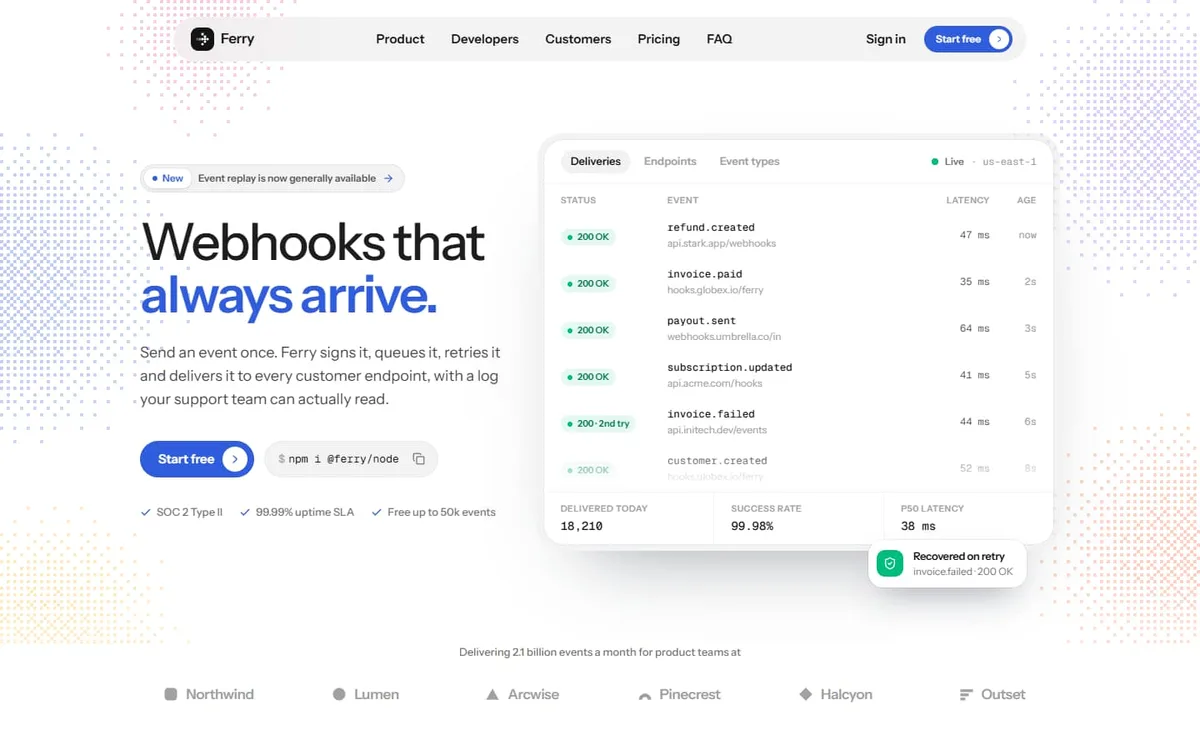
A clean, light landing page for developer tools and API products. Every product visual is built in code and animated: a live delivery log, a pipeline, six product panels, a code window with language tabs and a CLI terminal.
- Made for
- APIs and webhooks, Developer infrastructure, Email, auth and payments APIs
- Highlights
- Live delivery log hero with a retry that recovers
- Animated pipeline and six coded product panels
- Code window with language tabs and step highlights
- Usage-based pricing slider that prices every plan
- The look
- White surfaces, one cobalt accent and soft dithered colour fields. Text is set in Instrument Sans, code and data in Geist Mono, and every panel stays sharp at any size because none of it is a screenshot.
Sections
- 01
Hero
Headline, an install command with a copy button, and a live delivery log in which one request fails and recovers on retry.
- 02
Logo strip
Six placeholder wordmarks.
- 03
Build vs. buy
The same rows on both sides: weeks of work against “Included”.
- 04
How it works
Your app, your product and three customer endpoints, with packets travelling along the lines.
- 05
Product
A bento grid of six animated panels: retries, signing, replay, latency, regions and a customer portal.
- 06
Developers
Three steps beside a code window. Each step highlights its lines, and language tabs switch the sample.
- 07
Numbers
Four figures that count up.
- 08
Customers
One long story with its result, and two short quotes.
- 09
Pricing
Usage-based. A log-scale slider prices every plan at the chosen volume and marks the cheapest.
- 10
FAQ
Heading and contact card beside an accordion.
- 11
Closing card
A call to action beside a terminal that forwards events to localhost.
Remove a section by deleting its line in app/page.tsx, or move the line to reorder.
Built with
Its motion comes from free components in our library, shipped in components/hairline/ so you can use them anywhere else on the page too.
Make it yours
Every word, link and price lives in site.config.ts. TypeScript flags a missing or misspelled field, so you can’t quietly break a section.
| To change | Edit |
|---|---|
| Copy, links, plans, FAQ, sample events and code | site.config.ts |
| Accent colour, surfaces and code colours | app/globals.css (@theme) |
| Dither colours (hero, closing card) | site.config.ts → dither |
| Fonts | app/layout.tsx |
| Logo | components/ui/BrandMark.tsx |
| Section order | app/page.tsx |
Run it
$ npm install$ npm run devNode.js 18.18 or newer. No environment variables.
Before you go live
The product is a made-up webhook service called Ferry. Keep the structure and change the nouns: for an email API the log becomes sent and bounced messages, for auth it shows sign-ins. Each panel is one small component in components/visuals/, so you can also swap any of them for a screenshot.
Specifications
- Framework
- Next.js 15 (App Router), React 19
- Language
- TypeScript
- Styling
- Tailwind CSS v4 with design tokens and component styles
- Fonts
- Instrument Sans, Geist Mono, self-hosted with next/font
- Dependencies
- next, react, react-dom, lucide-react, motion, clsx, tailwind-merge
- Images
- None. Every visual is built in code.
- API keys and environment variables
- None
- Node.js
- 18.18 or newer
- Colour scheme
- Light
- Responsive
- Desktop, tablet and phone
- Accessibility
- Skip link, visible focus, keyboard navigation, reduced motion
- Deploys to
- Vercel, Netlify, Cloudflare Pages or any Node host
- Codebase
- 34 source files, about 3,800 lines
- Last updated
- Oct 7, 2026
License
One license, no tiers. The full text ships as LICENSE.md in the download.
You can
- Use it for your own products
- Use it for any number of client projects
- Change the code and design however you like
- Deploy the result commercially
You can’t
- Resell or share the files as a template, theme or UI kit
- Publish the source as a template in a public repository
Questions
What do I get when I buy Halftone?
The complete Halftone project as a download: the Next.js app, its config file, a README with setup and customisation notes, and the license. The download link arrives right after checkout.
Can I use Halftone for client projects?
Yes. One purchase covers your own products and any number of client projects, and you can change the code however you like. What you can’t do is resell or share the template files themselves as a template or UI kit.
Do I need API keys, a database or a backend?
No. It runs with npm install and npm run dev and deploys to Vercel, Netlify or Cloudflare Pages without any environment variables.
What should I change before I launch?
The product is a made-up webhook service called Ferry. Keep the structure and change the nouns: for an email API the log becomes sent and bounced messages, for auth it shows sign-ins. Each panel is one small component in components/visuals/, so you can also swap any of them for a screenshot.
Do I need to know Next.js?
Basic React helps, but most changes are text edits in site.config.ts. The README walks through colours, fonts and section order.
How do updates work?
Updates to Halftone are free. When a new version ships, download it again from the link in your order email.
Can I get a refund?
Yes. If Halftone isn’t right for you, reply to your receipt within 14 days and you get your money back.
Should I buy all-access instead?
If you’ll use more than two templates, yes. All-access is $99 for all 17 templates, including Halftone and every template added later. Three single templates would cost $117.
All-access
All 17 templates for $99.
Every template in the library, including Halftone, and every one added later. Same license, free updates. Less than three single templates.